
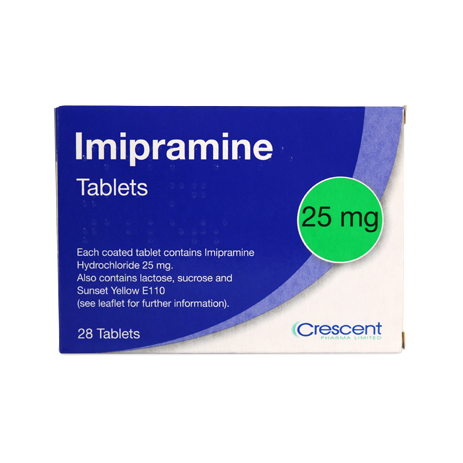

Brand/Nama Lain
Tofranil
Cara Kerja
Imipramine HCl bekerja sebagai antidepresan trisiklik yang memengaruhi keseimbangan neurotransmiter di otak, terutama serotonin dan norepinefrin. Obat ini menghambat reabsorpsi kedua neurotransmiter tersebut di celah sinaps, sehingga meningkatkan konsentrasi dan aktivitasnya di sistem saraf pusat. Dengan meningkatnya kadar serotonin dan norepinefrin, suasana hati menjadi lebih stabil, gejala depresi berkurang, dan rasa cemas dapat mereda.
Indikasi
Imipramine HCl diindikasikan untuk pengobatan depresi, terutama jenis depresi endogen atau depresi berat yang disertai gangguan suasana hati yang menetap. Selain itu, obat ini juga dapat digunakan untuk menangani gangguan kecemasan, gangguan panik, dan pada anak-anak kadang diresepkan untuk mengatasi enuresis nokturnal (mengompol di malam hari). Dalam beberapa kasus, imipramine dapat dipertimbangkan untuk gangguan nyeri kronis akibat neuropati, meskipun penggunaannya harus diawasi ketat oleh tenaga medis.
Kontraindikasi
Imipramine HCl dikontraindikasikan pada pasien yang memiliki hipersensitivitas terhadap imipramine atau antidepresan trisiklik lainnya. Obat ini juga tidak boleh digunakan pada pasien yang sedang atau dalam 14 hari terakhir menggunakan inhibitor monoamine oksidase (MAOI), karena dapat menyebabkan krisis hipertensi atau reaksi serius lainnya.
Imipramine dikontraindikasikan pada pasien dengan gangguan jantung berat seperti aritmia, gagal jantung kongestif, atau riwayat infark miokard. Penggunaannya juga perlu dihindari pada pasien dengan glaukoma sudut sempit atau retensi urin akibat hipertrofi prostat.
Efek Samping
Efek samping imipramine HCl dapat meliputi gejala antikolinergik seperti mulut kering, konstipasi, penglihatan kabur, dan retensi urin. Selain itu, pasien dapat mengalami rasa kantuk, pusing, peningkatan berat badan, atau hipotensi ortostatik (tekanan darah rendah saat berdiri).
Pada beberapa kasus, obat ini juga dapat menimbulkan efek kardiovaskular seperti aritmia atau takikardia, terutama pada dosis tinggi. Efek samping yang lebih jarang namun serius meliputi perubahan suasana hati ekstrem, kejang, atau reaksi alergi berat.
Sediaan
Imipramine HCl tersedia dalam berbagai bentuk sediaan untuk memudahkan penggunaan sesuai kebutuhan pasien. Bentuk yang paling umum adalah tablet atau kaplet oral dengan berbagai kekuatan dosis, seperti 10 mg, 25 mg, dan 50 mg.
Imipramine juga dapat tersedia dalam bentuk kapsul lepas lambat dan sediaan injeksi untuk penggunaan di rumah sakit dalam kondisi tertentu. Semua sediaan tersebut harus digunakan sesuai resep dan petunjuk dokter.
Dosis
Dosis imipramine HCl bervariasi tergantung pada usia, kondisi medis, dan respons pasien terhadap pengobatan.
- Pada orang dewasa dengan depresi, dosis awal biasanya 25–50 mg per hari, kemudian dapat ditingkatkan secara bertahap hingga mencapai dosis terapeutik 75–150 mg per hari, yang dibagi dalam beberapa kali pemberian.
- Pada anak-anak dengan enuresis nokturnal, dosis yang lebih rendah digunakan dan disesuaikan berdasarkan usia dan berat badan.
Dosis maksimum umumnya tidak melebihi 200 mg per hari untuk penggunaan rawat jalan. Penyesuaian dosis harus dilakukan secara hati-hati di bawah pengawasan dokter.
Keamanan
Imipramine HCl termasuk dalam kategori keamanan kehamilan kategori D menurut FDA, yang berarti terdapat bukti positif mengenai risiko terhadap janin manusia berdasarkan data penelitian atau pengalaman klinis. Namun, dalam situasi tertentu, manfaat penggunaannya pada ibu hamil mungkin masih lebih besar dibandingkan risikonya, misalnya pada kasus depresi berat yang tidak responsif terhadap terapi lain. Karena obat ini dapat diekskresikan melalui air susu ibu, penggunaannya selama menyusui juga tidak dianjurkan.
Interaksi Obat
Imipramine HCl dapat berinteraksi dengan berbagai obat yang memengaruhi sistem saraf pusat maupun fungsi jantung. Penggunaan bersamaan dengan inhibitor monoamine oksidase (MAOI) sangat berbahaya karena dapat menimbulkan krisis hipertensi atau reaksi toksik berat. Obat ini juga dapat meningkatkan efek sedatif alkohol, obat penenang, dan antihistamin, sehingga memperbesar risiko kantuk dan gangguan koordinasi.
Penggunaan bersama obat antiaritmia, antipsikotik, atau antidepresan lain dapat meningkatkan risiko gangguan irama jantung. Interaksi dengan obat yang menghambat enzim hati, seperti simetidin atau fluoksetin, juga dapat meningkatkan kadar Imipramine dalam darah dan memperbesar potensi efek sampingnya.
Mau tahu informasi seputar obat-obatan lainnya? Cek di sini, ya!
- dr. Alvidiani Agustina Damanik

Electronic Medicines Compendium. (2024, November 11). Imipramine Hydrochloride 25 mg/5 ml Oral Solution: Patient Information Leaflet (PIL). Essential Pharma Ltd. https://www.medicines.org.uk/emc/files/pil.13879.pdf
Health Canada. (n.d.). [Monograph for health‑care professionals: 00074990]. Government of Canada. https://pdf.hres.ca/dpd_pm/00074990.PDF
Japan Pharmacopoeia Database (JPDB). (n.d.). Imipramine hydrochloride [Monograph]. National Institute of Health Sciences, Japan. https://jpdb.nihs.go.jp/jp14e/14data/Part‑I/Imipramine_Hydrochloride.pdf
World Health Organization. (2016). Imipramine hydrochloride (Imipramini hydrochloridum). In The International Pharmacopoeia (6th ed.). https://cdn.who.int/media/docs/default-source/medicines/pharmacopoeia/omitted-monographs/imipramine_hydrochloride.pdf?sfvrsn=93e18691_5


/630212947b934.jpg)





