Definisi
Intoeing yang disebut juga dengan pigeon-toed, adalah kondisi kaki yang menghadap ke dalam dan tidak mengarah lurus ketika mereka berjalan atau berlari. Intoeing sering ditemukan pada anak-anak, terutama pada beberapa tahun pertama kehidupan. Kondisi ini umumnya disadari oleh orang tua saat anak masih bayi atau ketika mereka mulai belajar berjalan. Anak dengan intoeing rentan tersandung atau memiliki posisi yang aneh ketika berjalan atau lari.
Intoeing sebenarnya tidak menghalangi anak untuk belajar berjalan atau berlari. Sebagian besar kasus intoeing biasanya akan membaik dengan sendirinya tanpa bantuan alat penyangga, gips ataupun prosedur khusus. Kaki anak akan mengarah lurus seiring peningkatan usia dan ketika anak sudah semakin baik dalam berjalan serta berlari. Meskipun jarang, intoeing dapat menetap sampai masa dewasa.
Kaki biasanya hanya mengarah ke dalam dan tidak disertai nyeri atau peradangan. Oleh karena itu, bila anak mengeluhkan nyeri, pincang saat berjalan atau terlihat bengkak pada kaki, sebaiknya anak diperiksakan ke dokter untuk dievaluasi lebih lanjut.
Penyebab
Penyebab pasti kaki anak menghadap ke dalam dan bukannya lurus ke depan tidak diketahui. Anak-anak pada berbagai kelompok usia bisa menunjukkan tampilan kaki yang mengarah ke dalam karena berbagai hal. Namun diperkirakan kondisi ini berkaitan dengan:
- Riwayat keluarga dengan posisi kaki yang mengarah ke dalam semasa kecil.
- Ruang rahim yang sempit sehingga janin terdesak dan memengaruhi posisi kakinya.
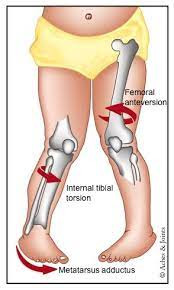
Terdapat tiga penyebab umum dari intoeing yang bisa muncul dengan sendirinya atau dikaitkan dengan masalah otot dan tulang lainnya, yaitu:
- Metatarsus aduktus
Bagian luar kaki normalnya berada dalam posisi lurus, pada kondisi ini kaki menghadap ke dalam. Metatarsus aduktus diperkirakan terkait dengan posisi janin saat berada di dalam kandungan.
- Torsi tibia interna
Tulang tibia adalah tulang yang berada di tungkai bawah, dan interna berarti bagian dalam. Torsi tibia interna mengacu pada kondisi tulang tibia yang menghadap ke dalam (antara pergelangan kaki dan lutut). Hal ini dapat terjadi sebelum lahir, ketika tungkai bawah janin berputar untuk menyesuaikan posisinya di dalam area sempit di kandungan. Setelah lahir, tungkai bayi seharusnya perlahan berputar kembali ke posisi normalnya.
Jika tungkai bawah bayi tetap terlihat mengarah ke dalam, hal ini akan menyebabkan torsi tibia interna. Kondisi ini sangat sering ditemukan pada bayi dan anak-anak.
- Torsi femur interna (anteversi femur)
Tulang femur adalah tulang paha, dan anteversi adalah gerakan berputar ke depan. Pada kondisi ini, bagian ujung atas dari tulang paha yang berada di dekat panggul, mengalami pembengkokan yang berlebihan. Tulang paha menghadap ke dalam sehingga pinggul lebih membengkok ke dalam daripada keluar.
Faktor Risiko
Beberapa faktor yang dapat meningkatkan kemungkinan terjadinya intoeing pada anak Anda adalah:
- Kehamilan dua janin (kembar) atau lebih.
- Jumlah cairan ketuban kurang bila dibandingkan dengan usia kehamilannya saat itu (oligohidramnion). Pada kondisi ini, ruang janin akan menjadi lebih sempit sehingga posisi janin bisa terdesak.
- Janin memiliki ukuran tubuh yang besar.
- Posisi bayi sungsang atau bokong berada di bawah kandungan.
Meskipun jarang, beberapa gangguan lain dapat berhubungan dengan intoeing. Gangguan tersebut meliputi:
- Cerebral palsy, kelompok penyakit terkait otak yang memengaruhi gerakan, otot dan postur tubuh.
- Clubfoot, kelainan bawaan kaki bengkok.
- Gangguan perkembangan sendi panggul.
- Kelainan bentuk tubuh lainnya yang langka.
Kami juga memiliki artikel cerebral palsy yang bisa Anda baca di sini.
Gejala
Pada intoeing, Anda dapat mengamati bahwa ketika anak berjalan atau berlari, posisi kaki anak terlihat menghadap ke dalam dan tidak mengarah lurus ke depan. Intoeing umumnya tidak menyebabkan nyeri atau peradangan sendi. Tampilan kondisi ini akan berbeda tergantung bagian mana dari kaki atau tungkai yang mengarah ke dalam.
- Metatarsus aduktus
Kaki anak mengarah ke dalam dari bagian tengah kaki sampai jari-jari kaki. Beberapa kasus dapat bersifat ringan, namun pada beberapa kasus lainnya kaki dapat lebih terlihat mengarah ke dalam dan kaku. Kasus metatarsus aduktus yang berat dapat sedikit menyerupai gangguan clubfoot, yaitu kelainan bentuk kaki yang lebih berat dan membutuhkan terapi segera setelah lahir.
- Torsi tibia interna
Ketika anak mulai berjalan, kaki membengkok ke arah dalam karena tulang tibia pada tungkai bawah (di atas kaki) akan menekukan kaki ke dalam.
- Torsi femur interna
Anak berjalan dengan kedua lutut dan kaki yang membengkok ke dalam. Hal ini normal terjadi pada anak kecil dan paling sering terlihat pada usia 5-6 tahun. Ketika duduk di atas lantai, anak dengan kondisi ini terkadang duduk dengan bokong berada di antara tumit, lutut menekuk dan kaki mengarah ke luar (seperti membentuk huruf W).
Tanda lain dari intoeing yang dapat Anda amati pada anak meliputi:
- Bentuk kaki seperti bulan sabit, terutama pada bayi.
- Terlihat pincang saat berjalan.
- Gangguan pada berjalan, misalnya sering tersandung atau jatuh.
Diagnosis
Tampilan kaki dan anggota gerak bawah pada anak biasanya cukup terlihat jelas. Orang tua bisa menyampaikan hal-hal yang dirasa mengkhawatirkan dan keluhan yang dirasakan oleh anak terkait kaki dan tungkainya. Dokter bisa bertanya mengenai riwayat penyakit anak, riwayat kehamilan dan persalinan Anda. Dokter kemudian akan melakukan pemeriksaan fisik pada area tungkai dan kaki.
Selanjutnya bila dirasa perlu, dokter dapat merekomendasikan pemeriksaan lebih lanjut seperti pemeriksaan pencitraan. Pemeriksaan pencitraan yang bisa dilakukan contohnya rontgen atau CT scan, untuk mengevaluasi dan mengobservasi tulang pada tungkai dan kaki.
Tata Laksana
Metatarsus aduktus
Pada kebanyakan bayi, kaki bersifat fleksibel dan akan membaik tanpa terapi dalam 4-6 bulan pertama kehidupan anak hingga berusia 2 atau 3 tahun.
Terapi dapat diberikan pada bayi yang berusia 6-9 bulan dengan kelainan bentuk kaki yang tergolong berat atau memiliki kaki yang sangat kaku. Pengobatan meliputi penggunaan cast (gips) atau sepatu khusus dengan tingkat keberhasilan yang tinggi.
Pemasangan cast akan dilakukan secara rutin untuk meregangkan dan memperpanjang otot anak. Penting untuk menjaga cast tetap bersih dan kering, agar tidak menyebabkan gatal dan bau tidak sedap.
Sementara itu, operasi untuk meluruskan kaki jarang diperlukan.
Torsi tibia interna
Kondisi ini juga biasanya akan membaik tanpa pengobatan khusus, biasanya sebelum anak mencapai usia sekolah atau sampai usia 8 tahun. Penggunaan splint (bidai), sepatu khusus, dan program latihan fisik tidak terlalu membantu untuk kasus ini.
Operasi untuk memperbaiki tulang dapat dilakukan pada anak yang berusia setidaknya 8-10 tahun dan memiliki pembengkokan yang berat sehingga menyebabkan gangguan berjalan yang signifikan.
Torsi femur interna
Kondisi ini biasanya akan membaik dengan sendirinya tanpa terapi pada saat anak mencapai usia 10 tahun. Tidak ada terapi spesifik seperti latihan fisik, brace, atau sepatu khusus yang dapat membantu memperbaiki torsi femur internal.
Operasi biasanya tidak direkomendasikan kecuali anak sudah berusia lebih dari 9 atau 10 tahun dan memiliki kelainan bentuk tulang yang berat, dan membuatnya mudah tersandung atau memiliki cara berjalan yang aneh.
Komplikasi
Intoeing biasanya tidak menyebabkan nyeri maupun menghalangi anak untuk berjalan berjalan atau berlari. Kondisi ini juga umumnya membaik dengan sendirinya. Pada kebanyakan kasus, kaki anak akan mulai menghadap lurus secara perlahan seiring pertumbuhan dan pertambahan usiannya sehingga kemampuan berjalan dan berlarinya akan meningkat.
Namun, jika kondisi ini tidak membaik dan tidak diobat, maka dapat terjadi komplikasi berikut yang meliputi:
- Cara berjalan yang tidak seimbang dan rentan menyebabkan cedera.
- Penurunan kemampuan atletik akibat gangguan pada berlari dan melompat.
- Kelainan bentuk kaki.
- Peradangan sendi.
Pencegahan
Pencegahan berkaitan dengan faktor risiko yang meningkatkan kemungkinan terjadinya penyakit. Penyebab intoeing bukan merupakan sesuatu yang dapat Anda ubah. Oleh karena itu, tidak ada cara spesifik untuk mencegah terjadinya intoeing. Namun, Anda bisa melakukan pemeriksaan rutin selama kehamilan untuk menemukan faktor risiko yang kemungkinan dimiliki, seperti cairan ketuban yang sedikit, janin berukuran besar, atau posisi janin sungsang.
Kapan Harus ke Dokter?
Intoeing adalah kondisi yang normal terjadi pada anak-anak. Normal bagi orang tua untuk khawatir mengenai kondisi anaknya, terutama ketika anak masih bayi dan tidak dapat memberitahu Anda jika sedang merasakan sakit.
Anda sebaiknya berkonsultasi ke dokter jika:
- Intoeing hanya terjadi pada salah satu kaki.
- Intoeing bersifat berat, kaki menjadi kaku dan kondisinya tidak kunjung membaik seiring berjalannya waktu.
- Intoeing menyebabkan tersandung pada anak usia sekolah sehingga memengaruhi keikutsertaan anak dalam berbagai aktivitas.
Selain itu, anak dengan intoeing yang disertai dengan nyeri, pembengkakan, atau pincang juga sebaiknya dibawa untuk berkonsultasi dengan dokter.
Mau tahu informasi seputar penyakit lainnya? Cek di sini, ya!
- dr Hanifa Rahma
Intoeing in children - royal children's hospital (2021). Available at: https://www.rch.org.au/uploadedFiles/Main/Content/rheumatology/intoeing.pdf (Accessed: December 31, 2022).
Intoeing - orthoinfo - aaos (2020) OrthoInfo. Available at: https://orthoinfo.aaos.org/en/diseases--conditions/intoeing/ (Accessed: January 1, 2023).
Pediatric intoeing - conditions and treatments: Children's National Hospital (no date) Conditions and Treatments | Children's National Hospital. Available at: https://childrensnational.org/visit/conditions-and-treatments/bones-joints-orthopaedics/intoeing (Accessed: January 1, 2023).
Pigeon toes (intoeing): Cleveland Clinic (2021). Available at: https://my.clevelandclinic.org/health/diseases/22186-pigeon-toes-intoeing (Accessed: January 1, 2023).