Brand/Nama Lain
Fluothane, Halotan, Halosin
Cara Kerja
Halothane adalah anestesi inhalasi yang bekerja dengan menekan sistem saraf pusat (SSP), terutama otak dan medula spinalis, untuk menciptakan efek sedatif, analgesik, dan hilangnya kesadaran. Halothane meningkatkan aktivitas neurotransmiter penghambat GABA pada reseptor GABA-A, sehingga menghambat eksitabilitas neuron melalui masuknya ion klorida.
Selain itu, halothane memblokir reseptor NMDA yang berperan dalam transmisi glutamat (neurotransmiter eksitatorik) dan mendukung efek analgesik. Di medula spinalis, ia menekan sinyal nyeri dan aktivitas motorik sehingga menciptakan relaksasi otot. Efek sistemik lainnya yaitu penurunan tekanan darah akibat vasodilatasi perifer dan depresi pernapasan.
Sekitar 20% halothane dimetabolisme di hati dan sisanya diekskresikan lewat paru-paru. Efek anestesinya cepat karena kelarutan lemak yang tinggi dan memungkinkan penetrasi cepat ke SSP.
Indikasi
Halothane digunakan untuk induksi dan pemeliharaan anestesi umum, baik pada anak-anak maupun dewasa, dalam berbagai prosedur pembedahan. Obat ini efektif untuk operasi minor hingga mayor seperti bedah abdominal, ortopedi, dan saraf. Halothane banyak digunakan untuk anak-anak karena relatif tidak mengiritasi saluran napas dan memiliki onset yang cepat.
Kontraindikasi
Halothane dikontraindikasikan pada pasien dengan riwayat hipersensitivitas atau hepatotoksisitas akibat halothane sebelumnya (halothane hepatitis). Halothane juga tidak boleh digunakan pada pasien dengan gangguan hati berat atau riwayat hipertermia maligna, kondisi serius akibat respons abnormal terhadap anestesi. Penggunaan pada pasien dengan penyakit jantung (misalnya aritmia atau gagal jantung) harus dipertimbangkan dengan hati-hati karena potensi aritmia yang dipicu oleh peningkatan sensitivitas terhadap katekolamin.
Efek Samping
Efek samping umum yang ditimbulkan yaitu hipotensi, bradikardia, dan depresi pernapasan. Beberapa efek samping serius meliputi halothane hepatitis, yang dapat berakibat fatal terutama setelah paparan berulang, serta hipertermia maligna yang ditandai dengan peningkatan suhu tubuh drastis dan kekakuan otot. Halothane juga dapat memicu aritmia jantung, khususnya bila dikombinasikan dengan obat simpatomimetik seperti adrenalin.
Sediaan dan Dosis
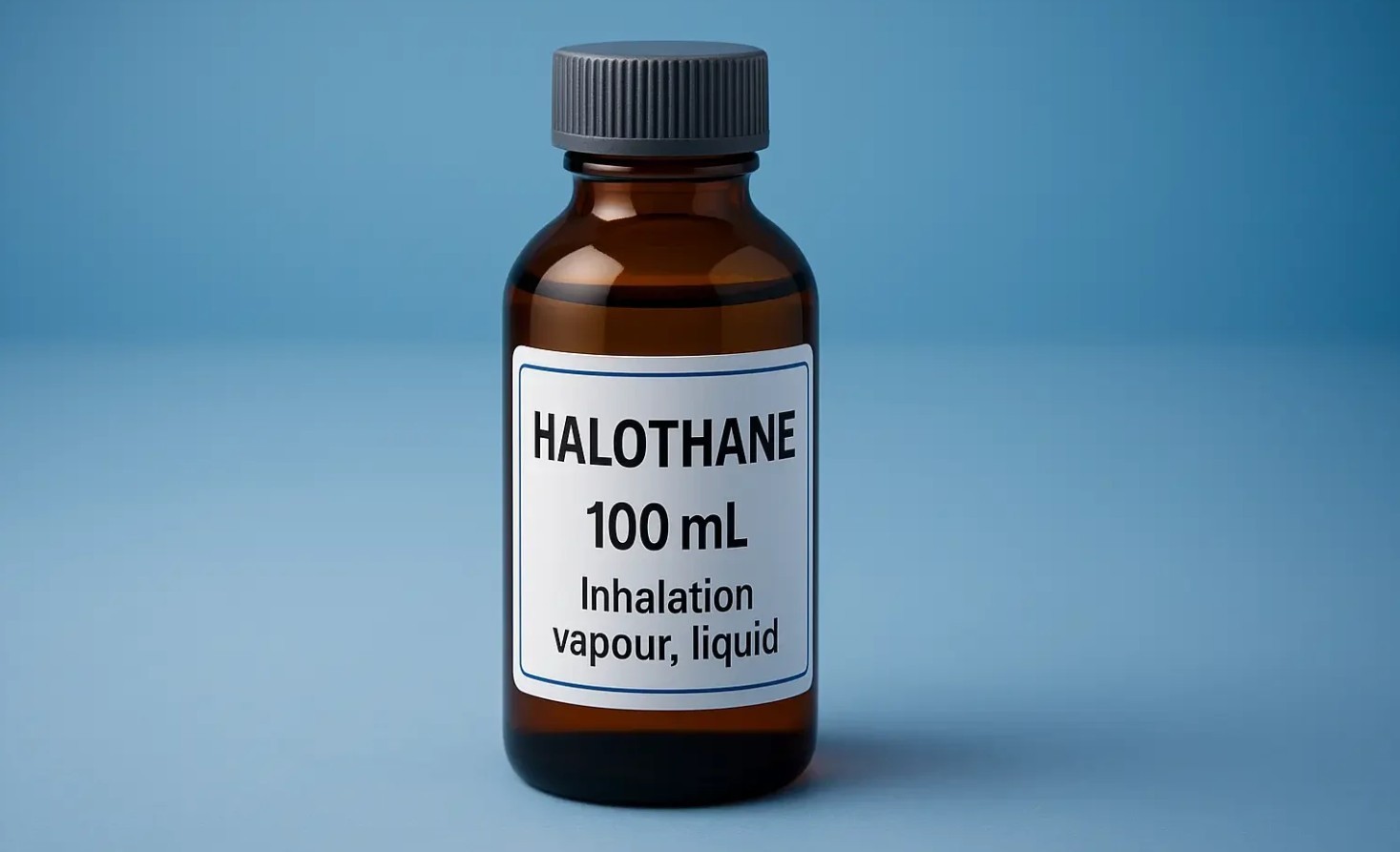
Halothane tersedia sebagai cairan inhalasi murni yang diuapkan melalui alat vaporizer. Dosis ditentukan berdasarkan konsentrasi dalam gas inspirasi (% volume), bukan satuan miligram. Untuk induksi, digunakan 0,5%–3%; untuk pemeliharaan, 0,5%–1,5%. Dosis pada anak lebih rendah karena sensitivitas yang lebih tinggi.
Keamanan
Penggunaan halothane harus diawasi ketat karena risiko hepatotoksisitas dan komplikasi jantung. Di banyak negara, penggunaannya menurun dan digantikan oleh agen anestesi yang lebih aman seperti sevoflurane. FDA menggolongkan halothane sebagai kategori kehamilan C, sehingga penggunaannya pada ibu hamil memerlukan pertimbangan manfaat dan risiko.
Interaksi Obat
Halothane berinteraksi dengan simpatomimetik (epinefrin), MAOI, antidepresan trisiklik, dan relaksan otot non-depolarizing, yang dapat memperkuat efek samping, terutama pada jantung dan hati. Penggunaan bersamaan dengan N₂O memperkuat efek anestesi. Waspadai juga interaksi dengan obat hepatotoksik lain, seperti paracetamol dan isoniazid.
Mau tahu informasi seputar obat-obatan lainnya? Cek di sini, ya!
- dr Nadia Opmalina
National Center for Biotechnology Information. (n.d.). Halothane. PubChem Compound Summary for CID 3562. U.S. National Library of Medicine. Retrieved September 15, 2025, from https://pubchem.ncbi.nlm.nih.gov/compound/Halothane
He, D. S., & Burt, J. M. (2000). Mechanism and selectivity of the effects of halothane on gap junction channel function. Circulation Research, 86(11), E104–E109. https://doi.org/10.1161/01.RES.86.11.E104
National Library of Medicine. (2018, January). Halogenated Anesthetics – LiverTox: Clinical and Research Information on Drug‑Induced Liver Injury. In LiverTox [Internet]. U.S. National Institutes of Health. https://www.ncbi.nlm.nih.gov/books/NBK548851/
Gyorfi, M. J., & Kim, P. Y. (2023, April 10). Halothane toxicity. In StatPearls. StatPearls Publishing. NCBI Bookshelf. https://www.ncbi.nlm.nih.gov/books/NBK545281/