Definisi
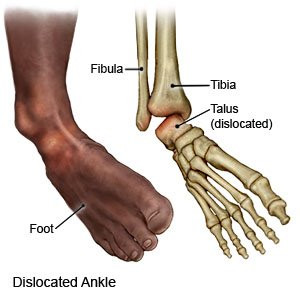
Dislokasi adalah kondisi dimana terdapat pemisahan abnormal antara tulang-tulang pada satu sendi. Ketika hal ini terjadi pada sendi pergelangan kaki, maka hal ini disebut dengan dislokasi pergelangan kaki. Hal ini termasuk suatu cedera yang berat.
Terdapat 3 tulang yang membentuk sendi pergelangan kaki yaitu:
- Tulang tibia (tulang kering)
- Tulang fibula (tulang betis)
- Tulang talus (tulang kaki)
Sendi pergelangan kaki memungkinkan kaki Anda untuk bergerak ke atas dan bawah. Normalnya, satu set ligamen yang kuat akan menahan semua tulang ini pada tempatnya.
Cedera berat dapat menarik atau merobek ligamen ini. Hal ini akan menyebabkan timbulnya ruang abnormal antara satu atau lebih tulang pada sendi tersebut. Ligamen seharusnya sangat kuat dan tidak mudah tertarik atau robek. Dislokasi pergelangan kaki sering terjadi bersamaan dengan patahnya 1 atau lebih tulang pergelangan kaki. Pada beberapa kasus, suatu dislokasi pergelangan kaki dapat terjadi tanpa disertai patah pada tulang pergelangan kaki. Pada kasus ini, dislokasi pergelangan kaki terjadi bersama dengan sprain atau cedera ligamen yang berat, yaitu dimana ligamen sobek.
Baca selengkapnya mengenai cedera ligamen, di sini: Cedera Ligamen - Definisi, Penyebab, Gejala dan Pengobatannya
Pada kebanyakan kasus, cedera akan mengakibatkan tulang talus berada di belakang tulang pergelangan kaki yang lain. Namun, tulang talus dapat terdorong ke salah satu sisi, ke atas, ataupun ke depan.
Dislokasi pergelangan kaki dapat terjadi pada semua orang dengan usia berapapun.
Penyebab
Dislokasi pergelangan kaki terjadi akibat cedera berat pada pergelangan kaki. Cedera ini merobek 1 atau lebih ligamen pergelangan kaki. Tanpa ligamen yang menahan tulang Anda pada tempatnya, tulang-tulang pergelangan kaki akan memisah. Hal ini dapat terjadi pada kecelakaan kendaraan bermotor. Selain itu, bisa juga terjadi ketika bermain olahraga, terutama yang melibatkan gerakan melompat. Dislokasi lebih mungkin terjadi ketika kaki Anda menekuk ke bawah saat mendapat tekanan.
Faktor Risiko
Anda dapat berisiko lebih tinggi untuk mengalami dislokasi pergelangan kaki, jika:
- Anda melakukan banyak aktivitas atletik, terutama olahraga yang melibatkan gerakan sisi-ke-sisi dan melompat (sepak bola, basket, soccer)
- Anda pernah mengalami cedera ligamen, fraktur, atau dislokasi pergelangan kaki sebelumnya
- pergelangan kaki Anda sudah tidak normal sejak lahir
- Anda memiliki kondisi yang menyebabkan ligamen lebih longgar, seperti sindrom Ehlers-Danlos
- Merokok
- Obesitas
- Pemakaian sepatu yang tidak tepat
Gejala
Dengan adanya cedera pada pergelangan kaki Anda, Anda akan mengalami gejala seperti:
- Nyeri yang segera dan berat
- Bengkak dan memar mendadak pada sendi
- Nyeri tekan pada pergelangan kaki
- Ketidakmampuan untuk memberi beban pada kaki
- Gangguan menggerakan pergelangan kaki atau kaki
- Bentuk pergelangan kaki berubah
- Tulang menonjol pada kulit
Diagnosis
Diagnosis dari dislokasi pergelangan kaki dapat dilakukan dengan anamnesis atau wawancara medis antara dokter dan pasien, pemeriksaan fisik, dan pemeriksaan penunjang.
Wawancara Medis
Dokter akan melakukan tanya jawab dengan menanyakan:
- Gejala yang dialami saat ini
- Riwayat trauma atau cedera
- Mekanisme dan proses terjadinya trauma atau cedera
- Kapan terjadinya trauma atau cedera
- Riwayat pengobatan
- Riwayat penyakit terdahulu
- Riwayat penyakit pada keluarga
Pemeriksaan Fisik
Kemudian dokter akan melakukan pemeriksaan fisik. Pemeriksaan fisik akan dimulai dengan pemeriksaan tanda vital seperti tekanan darah, suhu tubuh, laju napas, dan denyut nadi. Selanjutnya dokter akan melakukan pemeriksaan yang lebih spesifik dengan memeriksa bagian pergelangan kaki dan melakukan pemeriksaan berikut:
- Look: melihat bagian tungkai bawah dan pergelangan kaki. Dokter akan melihat adanya memar, perubahan warna, perubahan bentuk, adanya luka luar pada bagian pergelangan kaki.
- Feel: melakukan pemeriksaan dengan melakukan perabaan pada bagian pergelangan kaki. Dokter akan meraba bagian pergelangan kaki, memastikan adanya nyeri, benjolan, dan perubahan suhu akibat pembengkakan
- Move: mencoba menggerakkan pergelangan kaki untuk melihat fungsi saraf dan aliran darah pada tungkai bawah. Melihat apakah adanya gangguan pada bagian saraf dan membandingkannya dengan tungkai bawah yang satunya.
Pemeriksaan Penunjang
Selanjutnya dokter akan melakukan pemeriksaan penunjang. Pemeriksaan penunjang dapat berupa pemeriksaan radiologi:
- Rontgen : bila dokter mencurigai adanya tulang yang retak atau patah
- CT (Computerized Tomography) Scan : untuk melihat kerusahkan pada otot dan tendon disekitar siku
- MRI (Magnetic Resonance Imaging) : untuk melihat kerusahkan pada otot dan tendon disekitar siku
Anda dapat membaca selengkapnya mengenai cedera tendon, di sini: Cedera Tendon - Definisi, Penyebab, Gejala dan Pengobatannya
Tata Laksana
Cedera pada pergelangan kaki akan ditangani oleh dokter ortopedi atau spesialis bedah tulang. Terapi Anda dapat bervariasi bergantung pada tipe dislokasi dan adanya cedera lain, di antaranya:
- Obat-obatan
- Obat-obatan anti peradangan, seperti ibuprofen atau naproksen dapat direkomendasikan. Minumlah obat ini sesuai petunjuk dokter
- Obat anti nyeri lainnya seperti parasetamol dapat digunakan
- Pelemas otot mungkin dibutuhkan untuk merelaksasi pergelangan kaki dan mengurangi nyeri
- Reduksi tertutup, yaitu tindakan dokter mengembalikan posisi tulang ke posisi normal tanpa operasi
- Mengangkat pergelangan kaki lebih tinggi dari jantung
- Memberikan kompres dingin pada pergelangan kaki
- Kompres dingin harus dilakukan sekitar 10-15 menit setiap 2-3 jam, dan setelah aktivitas apapun yang membuat gejala bertambah berat. Gunakan ice packs atau pijat es
- Kompres hangat tidak boleh digunakan pada cedera yang baru namun dapat digunakan sebelum melakukan peregangan dan latihan penguatan otot dibawah pengawasan dokter atau pelatih olahraga. Gunakan heat pack selama 10 sampai 15 menit atau berendam air hangat.
- Operasi emergensi pada beberapa kasus
- Splint untuk menahan pergelangan kaki tidak bergerak
- Cast atau boot untuk menahan pergelangan kaki setelah pembengkakan berkurang
- Rehabilitasi. Rehabilitasi akan dibutuhkan setelah periode pembatasan pergerakan kaki atau operasi untuk mengurangi pembengkakan dan mengembalikan ruang gerak, kekuatan, dan keseimbangan. Hal ini harus dilakukan di bawah supervisi terapis fisik.
Anda mungkin membutuhkan operasi untuk menangani cedera yang lebih berat dan patah tulang yang kompleks. Selama operasi, dokter akan mengembalikan posisi tulang ke tempat semulanya agar dapat mengalami penyembuhan yang baik. Hal ini disebut dengan reduksi.dokter dapat menggunakan lempengan baja (plates) dan sekrup spesial untuk menjaga tulang pada posisinya. Hal ini disebut dengan fiksasi internal. Selain itu, dokter juga akan memperbaiki robekan pada ligamen.
Setelah kaki Anda mulai mengalami penyembuhan, dokter akan memberikan brace atau splint yang dapat dilepas. Hal ini bertujuan agar Anda dapat memulai terapi fisik. Latihan-latihan pada saat terapi akan membantu Anda mengembalikan dan menjaga ruang gerak dan kekuatan otot Anda. Anda biasanya akan membutuhkan penggunaan kruk atau tongkat selama beberapa bulan setelah cedera. Dokter atau terapis fisik Anda akan memberi tahu Anda waktu yang tepat bagi Anda untuk kembali ke aktivitas normal.
Dokter juga akan meresepkan obat-obatan untuk mencegah terbentuknya gumpalan darah pada tungkai selama masa penyembuhan Anda. Obat-obatan ini disebut dengan pengencer darah. Anda juga mungkin membutuhkan antibiotik jika cedera Anda disertai dengan adanya luka pada kulit.
Dokter akan memberikan rekomendasi mengenai diet yang baik untuk Anda. Diet yang kaya akan kalsium, vitamin D, dan protein akan membantu proses penyembuhan Anda. Dokter akan meminta Anda untuk tidak mengonsumsi obat anti nyeri yang dijual bebas tanpa berkonsultasi terlebih dahulu karena beberapa obat-obatan ini dapat menghambat proses penyembuhan tulang. Jika Anda merokok, dokter akan menyarankan Anda untuk berhenti merokok. Merokok juga dapat menghambat penyembuhan tulang.
Komplikasi
Anda dapat mengalami komplikasi akibat dislokasi pergelangan kaki, seperti:
- Kekakuan pada sendi (dapat diatasi dengan fisioterapi)
- Peradangan sendi pergelangan kaki yang menyebabkan nyeri pergelangan kaki kronis (jangka panjang)
- Infeksi, yang dapat membutuhkan terapi dengan antibiotik atau operasi lanjutan
- Kerusakan tulang yang gagal untuk sembuh dengan baik, yang dapat membutuhkan operasi lanjutan
- Nyeri dari plates dan sekrup yang digunakan pada saat operasi (alat ini dapat diambil di kemudian hari)
- Masalah pada penyembuhan luka
- Kerusakan pembuluh darah atau saraf akibat dislokasi atau patah tulang
- Gumpalan darah pada pembuluh darah
Risiko komplikasi Anda dapat bervariasi tergantung dari kesehatan Anda secara umum dan seberapa berat cedera yang Anda alami. Penting untuk mengikuti semua instruksi dokter dengan baik. Hal ini akan membantu Anda mengurangi risiko komplikasi
Pencegahan
Untuk mencegah dislokasi pergelangan kaki, hal yang dapat Anda lakukan adalah:
- Lakukan pemanasan dan peregangan yang baik sebelum beraktivitas
- Gunakan alat pelindung dan pendukung, seperti ankle brace
- Gunakan teknik yang baik saat berlari, melompat, dan memotong
- Pertahankan kondisi, fleksibilitas, dan kekuatan otot yang baik
- Pertahankan kesehatan dan kekuatan jantung pembuluh darah
Kapan Harus ke Dokter?
Segeralah ke dokter bila anda baru saja mengalami cedera atau trauma pada bagian pergelangan kaki. Beritahu dokter jika Anda mengalami sensasi baal (kehilangan sensorik) atau pembengkakan pada tungkai, atau demam tinggi, atau menggigil.
Mau tahu informasi seputar penyakit lainnya? Cek di sini, ya!
- dr. Monica Salim

Ankle dislocation (no date) Ankle Dislocation - Health Encyclopedia - University of Rochester Medical Center. Available at: https://www.urmc.rochester.edu/encyclopedia/content.aspx?contenttypeid=134&contentid=504 (Accessed: November 11, 2022).
Sports medicine: Ankle dislocation or subluxation (no date). Available at: https://www.nationwidechildrens.org/conditions/sports-medicine-ankle-dislocation-or-subluxation (Accessed: November 11, 2022).
Ankle dislocation - what you need to know (2022) Drugs.com. Available at: https://www.drugs.com/cg/ankle-dislocation.html (Accessed: November 11, 2022).