
Definition
Cushing's syndrome is a condition characterized by a range of symptoms resulting from an excessive amount of the hormone cortisol in the body. It is also referred to as hypercortisolism. While Cushing's syndrome and Cushing's disease are related, they are not the same. Cushing's disease specifically refers to increased production of Adrenocorticotropic Hormone (ACTH), whereas Cushing's syndrome encompasses all causes of elevated cortisol, including those from excess ACTH production.
Cortisol, often referred to as the "stress hormone," is produced by the adrenal glands and plays a role in increasing heart rate, blood pressure, muscle tension, blood sugar regulation, and breathing. It is primarily released during stressful situations.
The adrenal glands, located above the kidneys, are responsible for producing cortisol. This production is regulated by the pituitary gland in the brain and the hypothalamus, located above the pituitary gland.
When cortisol levels are too high or disrupted, it leads to a condition known as Cushing's syndrome, which can result in various bodily disorders, ranging from weight gain to more serious health issues like bone loss or stunted growth in children.
Cushing's syndrome can be caused by endogenous factors (excess cortisol is produced by the body itself) or exogenous factors, such as medications or tumors.
Causes
The primary cause of Cushing's syndrome is an excess of cortisol. Elevated cortisol levels can stem from both endogenous and exogenous factors. Some common causes of excess cortisol include:
- Use of glucocorticoid medications
- Glucocorticoid drugs, such as prednisolone, are used to treat various autoimmune disorders like asthma, rheumatoid arthritis, lupus, and sarcoidosis, among other conditions that involve chronic inflammation.
- Pituitary tumors
- These tumors, which produce ACTH (the hormone that signals the adrenal glands to produce cortisol), are responsible for about 80% of Cushing's syndrome cases.
- Adrenal tumors
- Tumors within the adrenal glands can result in excessive cortisol production. While these tumors are typically benign, they can sometimes develop into adrenal cancer, specifically cortical adrenal carcinoma, although this is rare.
- Lung, pancreatic, thyroid, and thymic tumors
- Ectopic ACTH syndrome occurs when a tumor develops outside the pituitary gland and begins producing ACTH, leading to increased cortisol production.
Risk Factor
A major risk factor for Cushing's syndrome is the long-term use of high doses of corticosteroids. If your doctor has prescribed corticosteroids for other medical conditions, it is essential to discuss the dosage and duration of use with them. Additionally, several other factors can increase the risk of developing Cushing's syndrome, including female gender, advancing age, and underlying conditions such as pituitary or adrenal tumors.
Symptoms
Individuals with Cushing's syndrome may experience a wide range of symptoms, and not everyone will present with the same set of signs. Some of the more common symptoms include:
-
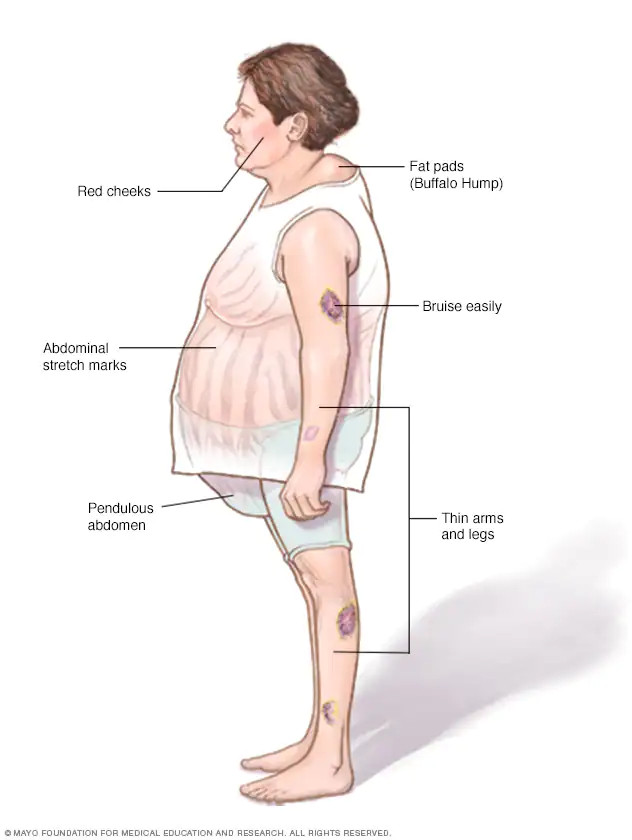
Weight gain, particularly in the face (leading to what is known as moon face), abdomen, back of the neck (referred to as a buffalo hump), and chest
-
A round, red face
-
Wounds that take longer than usual to heal
-
High blood pressure
-
Unusual hair growth on the face, neck, chest, abdomen, and thighs, or hair loss
-
Development of diabetes
-
Purple marks (striae) on the abdomen
-
Easy bruising, especially on the arms and legs
-
General fatigue and weakness
-
Blurred vision
-
Dizziness
-
Muscle weakness
-
Decreased muscle mass, particularly in the arms and legs
-
Erectile dysfunction or other forms of sexual dysfunction
-
Stunted growth in children
Diagnosis
Diagnosing Cushing's syndrome involves a series of tests, including a medical interview, physical examination, and laboratory assessments. Confirming the diagnosis can be challenging based on symptoms alone, as many of them overlap with other conditions.
Cushing's syndrome can sometimes be mistaken for conditions such as polycystic ovary syndrome (PCOS) or metabolic syndrome. To rule out other possible causes and get a clearer diagnosis, your doctor may recommend several tests:
- 24-hour urine cortisol test
- This test measures the level of cortisol in your urine over a 24-hour period, helping assess cortisol production.
- Midnight salivary cortisol test
- Cortisol levels are usually lowest in the middle of the night. This test measures cortisol levels between 11 p.m. and 12 a.m. High cortisol levels during these hours may indicate Cushing's syndrome.
- Low-dose dexamethasone suppression test
- In this test, you will take 1 mg of dexamethasone (a medication similar to cortisol) in the evening, and your cortisol levels will be measured the following morning. If you have Cushing's syndrome, your cortisol levels will remain elevated instead of decreasing, as would occur in a healthy individual.
- High-dose dexamethasone suppression test
- This test is similar to the low-dose dexamethasone suppression test but uses an 8 mg dose. It is typically conducted after the low-dose test shows high morning cortisol levels and elevated ACTH levels in the blood. This test helps identify the source of the excess cortisol.
- Blood test
- This measures ACTH (Adrenocorticotropic Hormone) levels in the blood. Low ACTH levels could suggest an adrenal tumor, while normal or high ACTH levels may indicate the presence of an ectopic tumor (a tumor producing ACTH outside the pituitary gland).
Once your doctor has confirmed a diagnosis of Cushing's syndrome, they will work to identify the underlying cause, whether it's related to medication or a tumor. If the cause is medication, such as glucocorticosteroids, your doctor will likely reduce the dosage or switch to an alternative medication. If a tumor is suspected, it could be located in the adrenal glands, pituitary gland, or other areas of the body. To pinpoint the source, your doctor may recommend the following tests:
-
CT Scan or MRI
-
A CT scan or MRI may be recommended to check for tumors in the adrenal glands. These tests can be done with or without intravenous contrast. They are highly sensitive for detecting adrenal tumors. A chest CT scan may also be performed to check for potential lung cancer.
-
-
Pituitary MRI
-
An MRI of the pituitary gland will help identify any potential tumors. However, it’s important to note that MRI scans may not always provide a definitive diagnosis. In fact, up to 50% of patients with Cushing's syndrome may have normal MRI results, and about 10% may have tumors unrelated to the syndrome.
-
-
Bilateral Inferior Petrosal Sinus Sampling (BIPPS)
-
This test helps determine the source of ACTH secretion. ACTH and other pituitary hormones are released into the bloodstream from the pituitary gland. This procedure has an accuracy rate of 95-98% in detecting the cause.
-
Management
The treatment approach for Cushing's syndrome depends on the underlying cause of the elevated cortisol levels. If the condition is caused by the use of glucocorticosteroids, your doctor may adjust the dosage or recommend switching to a non-glucocorticosteroid medication. If Cushing's syndrome is linked to a tumor, surgery may be recommended to remove the tumor. In some cases, medications like ketoconazole may be prescribed to slow down the production of cortisol.
Complications
Cushing's syndrome can be fatal if left untreated. Without treatment, Cushing's syndrome can lead to complications such as infections; blood clots, especially in the lungs and legs; depression; heart attacks; weight gain; memory problems or difficulty concentrating; high blood pressure or cholesterol; bone fractures; type 2 diabetes; prediabetes; or fasting blood sugar problems.
Prevention
There is no known way to prevent Cushing's syndrome. Cortisol is essential for many bodily functions, and the body requires a balanced amount for optimal performance. While cortisol itself is not harmful, excessive levels can lead to serious health issues. If you are taking glucocorticoids or steroids, it is important to work closely with your doctor to monitor your progress and adjust medication as necessary.
When to See a Doctor?
If you notice any symptoms of Cushing's syndrome, it’s crucial to consult with your doctor. Should your symptoms require further investigation, your doctor may refer you to an endocrinologist for specialized evaluation and treatment.
Looking for more information about other diseases? Click here!
- dr Hanifa Rahma
Cushing Syndrome. (2021). Retrieved 27 February 2023, from https://www.mayoclinic.org/diseases-conditions/cushing-syndrome/symptoms-causes/syc-20351310
Cushing’s Syndrome. (2018). Retrieved 27 February 2023, from https://www.niddk.nih.gov/health-information/endocrine-diseases/cushings-syndrome
Cushing’s Syndrome. (2021). Retrieved 27 February 2023, from https://www.nhs.uk/conditions/cushings-syndrome/
Cushing Syndrome. (2022). Retrieved 27 February 2023, from https://my.clevelandclinic.org/health/diseases/5497-cushing-syndrome
Cushing Syndrome : Everything You Need to Know. (2022). Retrieved 27 February 2023, from https://www.healthline.com/health/cushings-syndrome
Cushing Syndrome. (2021). Retrieved 27 February 2023, from https://medlineplus.gov/ency/article/000410.htm
Cushing Syndrome. (2021). Retrieved 27 February 2023, from https://www.webmd.com/a-to-z-guides/cushing-syndrome