Definition
Transposition of the great arteries (TGA) is a congenital heart defect present from birth, characterized by cyanosis (a bluish tint to the skin). Affected babies often appear bluish during the first 24 hours of life. TGA accounts for 7% of all congenital heart defects, with an incidence of about 1 in 5,000 births.
Causes
TGA develops during pregnancy while the baby’s heart is still forming, but the exact cause is not entirely understood.
To understand TGA, it helps to know how the heart functions to circulate blood. Normally, the arteries that carry blood from the heart to the lungs (pulmonary arteries) connect to the right ventricle. Oxygen-rich blood from the lungs is then pumped through the left atrium into the left ventricle, and the aorta (the body’s largest artery) pumps the oxygen-rich blood throughout the body.
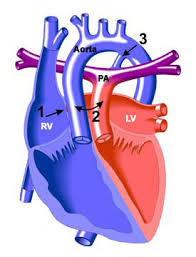
Complete Transposition of the Great Arteries (D-TGA)
In this condition, also called dextro-transposition, the pulmonary artery and aorta are reversed. The pulmonary artery connects to the left ventricle, and the aorta connects to the right ventricle.
Congenitally Corrected Transposition (L-TGA)
This rare form is also called levo-transposition. In this condition, the heart's chambers are reversed. The left ventricle is on the right side of the heart and receives blood from the right atrium, while the right ventricle is on the left side and receives blood from the left atrium.
Risk Factor
TGA is often linked to genetic factors. Babies are at a higher risk if there is a family history of congenital heart defects. Additionally, genetic syndromes such as Down syndrome, Turner syndrome, Marfan syndrome, or Noonan syndrome can contribute to the development of cyanotic congenital heart disease.
Several other factors can increase the risk of TGA. If a pregnant woman is exposed to certain chemicals, medications, or infections, the fetus may be at an increased risk of heart defects. Uncontrolled gestational diabetes (diabetes that occurs during pregnancy) also raises the risk of TGA in the fetus.
Other risk factors include a history of rubella or viral infections during pregnancy, alcohol consumption during pregnancy, and smoking during pregnancy.
Symptoms
Transposition of the great arteries (TGA) may be detected during a routine prenatal checkup. However, in some cases, symptoms might not appear until years later. After birth, signs and symptoms of TGA may include:
-
Bluish skin (cyanosis)
-
Difficulty breathing (shortness of breath)
-
Weak pulse
-
Decreased appetite
-
Weight issues
Diagnosis
To diagnose TGA, the doctor will begin with a medical interview, physical examination, and any additional tests that might be needed.
During the medical interview, the doctor will inquire about the patient's current symptoms. It is important to provide a detailed description of the symptoms, including when they started, as this information is essential for an accurate diagnosis. If TGA is suspected, the doctor will proceed with a physical examination and may recommend further tests.
During the physical examination, the doctor will assess the patient based on the symptoms presented. The doctor will look for clinical signs, such as cyanosis (bluish skin). If these signs point to TGA, additional tests may be conducted to confirm the diagnosis.
Diagnostic tests play an important role in confirming TGA. X-rays can provide a view of the heart and the positioning of arteries and veins. For more detailed images, an echocardiogram (a cardiac ultrasound) may be performed, which helps visualize heart abnormalities.
Management
The first step in treating TGA is to ensure the mixing of oxygen-rich blood with oxygen-poor blood. The baby will be given prostaglandin medication intravenously (through a vein) to help keep a blood vessel called the ductus arteriosus open. This enables the circulation of both types of blood. In some cases, a surgical procedure called an atrial balloon septostomy is performed, where a balloon catheter creates an opening between the right and left atria, allowing the blood to mix.
Permanent treatment for TGA requires heart surgery to reposition the arteries. This is done through a procedure called arterial switch surgery (ASO). Before the ASO, an atrial switch procedure may be performed.
Complications
The complications of TGA depend on the type of condition.
Complete transposition of the great arteries (D-TGA) can cause several complications, such as:
-
Lack of oxygen to the body tissues, leading to hypoxia.
-
Heart failure, a condition where the heart cannot pump sufficient blood to meet the body’s needs. This occurs because the heart chambers are pumping under higher-than-normal pressure, which weakens or stiffens the heart muscles.
Congenitally corrected transposition (L-TGA) can also result in complications, including:
-
Decreased heart pumping ability.
-
Complete heart block, where electrical disturbances in the heart’s structure cause abnormal heart rhythms.
-
Heart valve abnormalities, which occur due to improper blood flow through the heart, leading to valve dysfunction and regurgitation (backflow of blood). This reduces the heart's pumping effectiveness.
Prevention
Here are some preventive measures to reduce the risk of congenital heart disease:
-
If you have a family history of congenital heart disease or have previously had a child with such a condition, consult your doctor before planning a pregnancy.
-
It is recommended to ensure all immunizations are up-to-date before pregnancy, including the rubella vaccine, and to start taking a multivitamin with 400 micrograms of folic acid.
-
Avoid consuming alcohol.
-
Pregnant women with diabetes should manage their blood sugar levels effectively.
-
Maintain a balanced and nutritious diet during pregnancy.
When to See a Doctor?
Complete transposition of the great arteries (D-TGA) is often detected before birth, shortly after birth, or within the first hour of life. Prenatal diagnosis of TGA can be made through a fetal echocardiogram. If your baby shows symptoms such as bluish skin, it is important to consult a cardiologist or pediatrician. They will conduct a medical interview, physical examination, and other tests to confirm the diagnosis and provide appropriate treatment.
Looking for more information about other diseases? Click here!
- dr Hanifa Rahma
Szymanski MW, Moore SM, Kritzmire SM, et al. Transposition Of The Great Arteries. [Updated 2022 May 11]. In: StatPearls [Internet]. Treasure Island (FL): StatPearls Publishing; 2022 Jan-. Available from: https://www.ncbi.nlm.nih.gov/books/NBK538434/
Medline Plus. Transposition of the great arteries. October 2021. https://medlineplus.gov/ency/article/001568.htm#:~:text=Transposition%20of%20the%20great%20arteries%20(TGA)%20is%20a%20heart%20defect,%2D%2D%20are%20switched%20(transposed).
Mayo Clinic. Transposition of the great arteries. June 2022. https://www.mayoclinic.org/diseases-conditions/transposition-of-the-great-arteries/symptoms-causes/syc-20350589
Healthline. Cyanotic congenital heart disease. March 2018. https://www.healthline.com/health/cyanotic-heart-disease