Definition
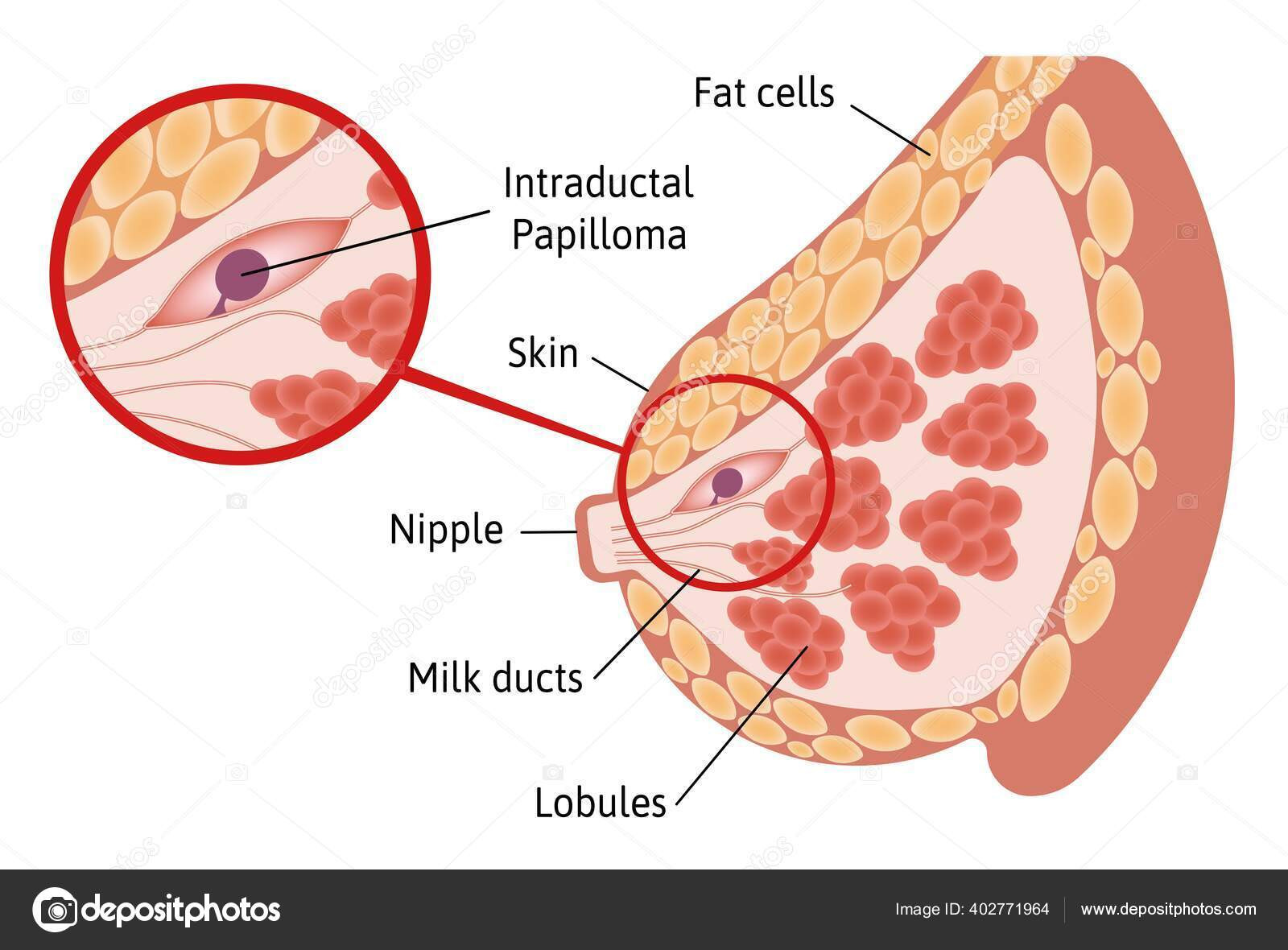
An intraductal papilloma is a benign (non-cancerous) tumor that grows within the milk ducts of the breast. It is composed of milk gland tissue along with fibrous connective tissue and blood vessels, hence referred to as fibrovacular tissue. Intraductal papillomas can be solitary or multiple. This condition is most commonly found in women over the age of 40, with the risk increasing with age.
Solitary papillomas often grow in the larger ducts near the nipple. This condition frequently causes clear or slightly blood-tinged nipple discharge, particularly when the tumor occurs on only one side of the breast. The tumor may be felt as a small lump behind or beside the nipple.
Papillomas that develop in smaller milk ducts and are multiple in number are usually located deeper within the breast or farther from the nipple. This type of papilloma less frequently causes nipple discharge and is referred to as papillomatosis. In papillomatosis, there are several small areas of cell growth within the ducts, so the lump is not as prominent as with solitary papillomas.
Causes
The exact cause of intraductal papillomas is unknown. These tumors form due to faster-than-normal cell growth within the ducts. Excessive cell growth leads to tumor formation.
Risk Factor
Experts suggest that the development of intraductal papillomas is influenced by factors such as:
- A family history of intraductal papillomas
- Hormone replacement therapy
- Hormonal contraceptive use
- Long-term estrogen exposure
Symptoms
Intraductal papillomas may present with symptoms such as:
- A small lump in the breast
- Clear or blood-tinged discharge from the nipple Intraductal papillomas are usually painless, although some individuals may experience discomfort or pain around the tumor area
Diagnosis
Intraductal papillomas are often asymptomatic and may be discovered during:
- Routine breast screening
- Breast surgery
If a lump, particularly near the nipple, is detected or felt, your doctor may recommend a series of tests to assist in diagnosis. These may include:
- Physical breast examination
- Mammogram (breast X-ray)
- Breast ultrasound
- Core biopsy (using a needle to take a sample of breast tissue for microscopic examination)
- Fine needle aspiration (FNA) to collect cells for microscopic examination
- Ductogram (galactogram), which involves injecting contrast dye into the duct from which abnormal discharge is coming and taking an X-ray. This test can sometimes help identify papillomas.
A physical examination or imaging may detect a tumor or abnormality in the breast, but a biopsy is often required to confirm the diagnosis. In some cases, surgery (removal of the tumor or affected breast duct) may be performed to better visualize the tumor. If the biopsy does not provide a definitive result, or if more breast tissue is needed for diagnosis, or if the abnormal area is difficult to reach, your doctor may recommend vacuum-assisted biopsy. This procedure takes slightly longer than core biopsy and uses a needle connected to a vacuum to extract breast tissue for examination.
Management
Treatment for papillomas depends on factors such as size, number, and whether the papilloma causes symptoms. Papillomas are sometimes associated with more serious breast conditions, so your doctor may recommend surgery to remove the tumor and affected duct.
Several types of surgery are commonly performed for papilloma:
- Excisional biopsy
This procedure can be done under local or general anesthesia. The removed breast tissue will be examined under a microscope to help confirm the diagnosis. You will receive information on wound care before being discharged from the hospital. Surgery may leave a scar, but it usually fades over time.
- Vacuum-assisted biopsy
Your doctor may recommend this type of biopsy to remove intraductal papillomas. After injecting a local anesthetic, a small incision is made in the skin. A probe connected to a vacuum is inserted through this incision. With the help of a mammogram or ultrasound, the vacuum extracts breast tissue through the probe until the entire abnormal area is removed. The procedure is usually performed under local anesthesia. The removed tissue is sent to a lab for microscopic examination. This procedure may cause bruising and pain for a few days afterward, but your doctor may prescribe pain relief.
If you have had surgery but continue to experience symptoms such as nipple discharge, you may need additional surgery. Your doctor may recommend:
- Microductectomy: Removal of the affected breast duct
- Total duct excision: Removal of all major breast ducts
Surgery usually eliminates symptoms, but finding all the ducts affected by papillomas can be challenging. You may need additional duct removal if nipple discharge persists. Breastfeeding cannot be done if all major ducts have been removed, but it is still possible if microductectomy was performed since other ducts remain.
You should rest after surgery and avoid lifting heavy objects. Most patients can return to work after a few days. Individuals with multiple intraductal papillomas (papillomatosis) or papillomas containing atypical (abnormal) tumor cells may require follow-up every few months as recommended by their doctor. Even if your intraductal papilloma has been removed, it is important to continue regular self-examinations and see your doctor if you notice any changes in your breast.
Complications
Intraductal papillomas generally do not pose a risk of turning into malignant (cancerous) tumors or increasing the risk of other types of breast cancer. However, some intraductal papillomas containing abnormal but non-cancerous cells (atypical cells) may increase the risk of breast cancer in the future. Individuals with multiple intraductal papillomas (papillomatosis) may also have a slightly higher risk of developing breast cancer.
The more common complications are related to surgery, including bleeding, infection, scarring, and anesthesia risks. However, these postoperative complications can be minimized with proper wound care and follow-up visits to the doctor.
Prevention
There is no known way to prevent intraductal papillomas, as the exact cause of this condition is also unknown. Regular breast self-examinations and screening with ultrasound and mammograms can help detect breast conditions early.
When to See a Doctor?
Contact your doctor if you notice clear or blood-tinged discharge from the nipple or if you find a lump in your breast.
Looking for more information about other diseases? Click here!
- dr. Alvidiani Agustina Damanik
American Cancer Society. (2022). Intraductal papillomas of the breast: Benign conditions. Available at: https://www.cancer.org/cancer/breast-cancer/non-cancerous-breast-conditions/intraductal-papillomas.html
Breast Cancer Now. (2018). Benign breast conditions: Intraductal papilloma. Available at: https://breastcancernow.org/information-support/have-i-got-breast-cancer/benign-breast-conditions/intraductal-papilloma
Li A. (2022). Intraductal papilloma. In: StatPearls [Internet]. Treasure Island (FL): StatPearls Publishing; 2022 Jan-. Available from: https://www.ncbi.nlm.nih.gov/books/NBK519539/