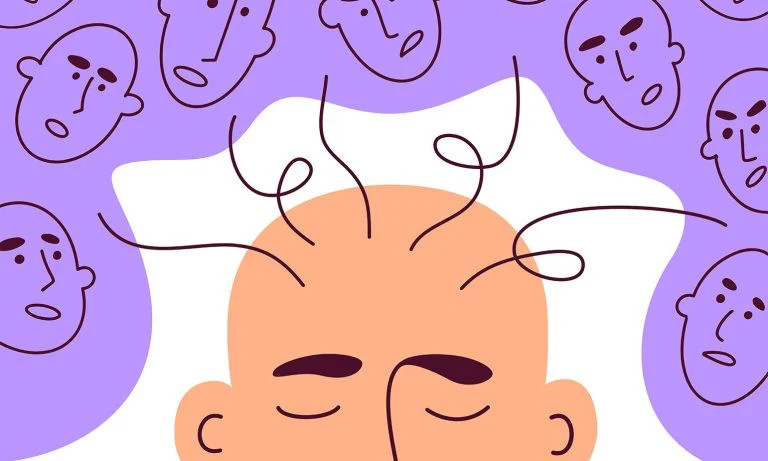


Definition
Schizophrenia is a serious and chronic mental disorder that affects the way an individual thinks, behaves, shows emotions, sees and feels reality, and relates to other people due to his or her interpretation of reality that is not normal. Although schizophrenia does not appear as often as other mental disorders, it can last the longest and interfere with daily life. Individuals often experience difficulties in society, the workplace, school, and personal relationships.
Causes
The exact cause of schizophrenia is unknown, but researchers believe that a combination of genetic factors, environmental factors, and chemical interactions in the brain play a role in the emergence of this condition.
In this condition, neurotransmitters or compounds that send signals between brain nerve cells are considered abnormal. Dopamine and serotonin compounds become hyperactive, and glutamine and GABA compounds become less active. Apart from neurotransmitter abnormalities, abnormalities in the central nervous system or brain structure are also thought to play a role in the emergence of schizophrenia. Genetic factors are also considered to have a big role, where children have a 40% risk of having schizophrenia if both parents also suffer from schizophrenia.
Risk factor
Schizophrenia can affect everyone from all races and cultures. However, a family history of schizophrenia can increase a person's risk of developing schizophrenia. Although it can appear at any age, symptoms of schizophrenia usually first appear in boys who are teenagers or in the second and third decades of their lives. In women, symptoms usually appear around 20-30 years old.
This disorder is experienced by men and women equally, although the symptoms usually appear earlier in men. The earlier the symptoms appear, the more severe the disease.
Symptoms
In schizophrenia, a person can experience psychosis, symptoms where an individual cannot differentiate reality from his imagination. The world seemed like a confusing mix of thoughts, images, and sounds. The patient's behavior becomes very strange and surprising. This sudden change in behavior and personality is called a psychotic episode, which occurs when the individual loses contact with reality.
The severity of schizophrenia varies between individuals. Some individuals experience only one psychotic episode, whereas other individuals may experience many episodes during their lifetime, but they can live a normal life in between episodes. There are also other individuals who experience difficulty functioning over time and experience little improvement between psychotic episodes. Schizophrenia symptoms can appear to worsen and improve.
The period during which the first symptoms appear and before full psychosis is referred to as the prodromal period, which can last for several days, weeks, or even years. This period is difficult to notice because there is usually no specific trigger. Behavioral changes that may appear are:
- Changes in school grades
- Withdraw from society
- Difficulty concentrating
- Easily angry
- Sleeping difficulty
Positive or psychotic symptoms that can appear in schizophrenia patients are delusions, hallucinations, disturbances in the cognitive function of the brain, and catatonia.
- Delusions are false and sometimes strange beliefs which are not based on reality and are persistent. The individual refuses to discard the delusion even when presented with the facts. For example, an individual with delusions may believe that other individuals can hear their thoughts, that they are God or demons, or that other individuals can input thoughts into them.
- Hallucinations are unreal sensations that are also felt to be persistent. The most common hallucination experienced by individuals with schizophrenia is hearing voices. These sounds can be comments on an individual's behavior, insults, or commands. Hallucinations do not only take the form of sounds but can also take the form of strange smells, a strange taste in the mouth, or sensations on the skin, even though there is no object touching the skin.
- Catatonia is a condition where an individual can stop talking and his body remains in one position for a long time.
- Cognitive symptoms can include difficulty understanding and using information to make decisions, inability to focus, and usually, patients' difficulty realizing that they are experiencing a problem.
Schizophrenic patients also have negative symptoms. These negative symptoms can manifest in the form of behavior such as limited or lost emotions, reduced energy, less talk, and no motivation. The individual feels a loss of pleasure or interest in life. Because of the above, patients usually have poor self-care and hygiene habits.
Diagnosis
If there are symptoms of schizophrenia, the doctor will ask for a complete medical history and sometimes perform a physical examination. Interviews are usually not only carried out with patients, but also with family members or guardians of patients. Although there are no laboratory tests that can specifically diagnose schizophrenia, doctors can use several tests such as blood tests or brain imaging to rule out the possibility of other physical illnesses or compound/drug intoxication as the cause of the symptoms.
An individual can be diagnosed with schizophrenia if at least 2 of the following symptoms are present for 6 months:
- Delusions
- Hallucinations
- Chaotic (disorganized) conversation
- Catatonic behavior
- Negative symptoms
One of these symptoms must be delusions, hallucinations, or disorganized conversation. During these 6 months, the individual must experience active symptoms for 1 month. His symptoms negatively affect his social or work life and cannot be caused by another condition.
Management
This disease cannot be cured but can be controlled with appropriate therapy. The goal of schizophrenia treatment is to reduce symptoms and the possibility of relapse or recurrence of symptoms. Therapy for schizophrenia includes:
- Antipsychotic drugs are given to relieve symptoms such as thought disorders, hallucinations, and delusions and to prevent relapse.
- Coordinated Specialty Care (CSC) is a group approach where there is a combination of medication and therapy with social, employment and educational service interventions. The family is also involved as much as possible to help the patient live a normal life.
- Psychosocial therapy is provided so that patients can learn to manage symptoms, identify early signs of relapse, and create a relapse prevention plan.
- Rehabilitation focuses on social skills and job training to help individuals function in the community and live as independently as possible.
- Cognitive remediation is a learning technique to overcome information processing problems. Exercises usually strengthen mental skills, including attention, memory, planning, and organization.
- Individual psychotherapy can help individuals better understand their illness and learn coping and problem-solving skills.
- Family therapy aims to help better the families of those who have schizophrenia.
- Group therapy an environment that can provide continuous support to each other
- Hospitalization is aimed at individuals who experience severe symptoms, are a danger to themselves or others, or are unable to care for themselves at home.
- Electroconvulsive therapy (ECT) is a procedure using a special machine where electrodes are placed on the scalp, and small electric shocks are given while the patient sleeps after being anesthetized. Usually, therapy is needed 2-3 times a week for several weeks. This therapy may be used if treatment is ineffective or if symptoms of severe depression or catatonia make treatment difficult.
Complications
With correct therapy, individuals with schizophrenia can generally have productive and meaningful lives. Depending on the severity of the disease and the individual's level of compliance with treatment, patients can also live with their family or community and not in a psychiatric hospital.
If left untreated, complications such as the following may occur:
- Suicidal attempts and thoughts
- Anxiety disorders and obsessive-compulsive disorder (OCD)
- Depression
- Abuse of drugs, alcohol or other compounds such as nicotine
- Unable to work or go to school
- Financial problems and homelessness
- Social isolation
- Health and medical problems
- Aggressive behavior
Prevention
There is no way to prevent schizophrenia, but early diagnosis and treatment can avoid and reduce relapses and frequent hospitalizations. It can also reduce disruption to the individual's life, family, and social relationships.
When to See a Doctor?
Individuals with schizophrenia are often unaware that their difficulties stem from a mental disorder that requires medical attention, so it is usually family or friends who seek help. If there is someone who appears to have symptoms of schizophrenia, talk to that person about your concerns and provide support so they can see a doctor.
If the person is a danger to themselves or others or cannot manage their food, clothing, and shelter, immediately contact the emergency department so that the individual can be evaluated by a doctor.
Looking for more information about other diseases? Click here!
- dr. Yuliana Inosensia
Bhandari, S. (2022). Schizophrenia Health Center. Retrieved 5 February 2022, from https://www.webmd.com/schizophrenia/mental-health-schizophrenia
Mayo Clinic Staff. (2020). Schizophrenia. Retrieved 5 February 2022, from https://www.mayoclinic.org/diseases-conditions/schizophrenia/symptoms-causes/syc-20354443
WHO. (2022). Schizophrenia. Retrieved 5 February 2022, from https://www.who.int/news-room/fact-sheets/detail/schizophrenia
National Institute of Mental Health. (2020). Schizophrenia. Retrieved 5 February 2022, from https://www.nimh.nih.gov/health/topics/schizophrenia
Hany, M., Rehman, B., Azhar, Y., Chapman, J. (2021). Schizophrenia. Retrieved 5 February 2022, from https://www.ncbi.nlm.nih.gov/books/NBK539864/