
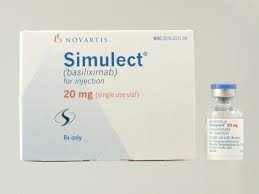

Other Brands/Names
Simulect
How It Works
Basiliximab is an immunosuppressant that lowers immune activity so the body does not attack a transplanted organ (an organ moved from a donor to a recipient through surgery). By tempering the immune response, this medicine helps protect the transplanted organ from immune-mediated damage.
Indications
Basiliximab is given with other medicines, such as cyclosporine and corticosteroids, to help prevent rejection after an organ transplant. Rejection happens when the recipient’s immune system attacks the new organ. Using this medicine allows the transplanted organ to function as intended.
Contraindication
Do not administer basiliximab if any of the following apply:
- Known hypersensitivity or allergy to basiliximab or any of its components
- Pregnancy: People who can become pregnant must use effective contraception before starting, throughout treatment, and for 4 months after the last dose
Side Effects
Possible reactions include pain or redness where the injection is given. Gastrointestinal symptoms may also occur, such as:
- Nausea
- Abdominal pain
- Diarrhea
- Constipation
Medicines that suppress the immune system, including basiliximab, can raise the risk of certain infections or illnesses. Contact your doctor promptly if you develop serious symptoms, including:
- Fever
- Weakness
- Swollen lymph nodes (tell your doctor right away if you notice any lumps)
- Night sweats
- Persistent cough or sore throat
- Sores around the mouth or genitals
- Painful urination
- Vision changes
- Unintentional weight loss
Types
Basiliximab is supplied as a 20 mg vial of powder for injection.
Dosage
Adult Dosage
- 20 mg by injection or intravenous infusion over 20–30 minutes, given 2 hours before the transplant procedure.
- A second 20 mg dose is administered 4 days later.
- Withhold the second dose if a severe hypersensitivity reaction occurs or if the transplant fails.
Pediatric Dosage
- Body weight < 35 kg:
- 10 mg by injection or intravenous infusion over 20-30 minutes, 2 hours before surgery; repeat once 4 days later.
- Body weight > 35 kg:
- Use the adult dosing schedule.
- Withhold the second dose in the event of graft loss or a severe hypersensitivity reaction and transplant failure.
Safety
Do not receive vaccinations without medical advice, and avoid close contact with people who have recently received the oral polio vaccine or the intranasal influenza vaccine. It is not known whether this medicine passes into breast milk. Consult your doctor before breastfeeding.
Drug Interactions
- May reduce the response to inactivated vaccines (vaccines containing killed organisms).
- May increase adverse effects of live vaccines (vaccines containing weakened live organisms). Do not receive live vaccines while using basiliximab.
Looking for more information about other drugs? Click here!
- dr Hanifa Rahma
Pusat Informasi Obat Nasional BPOM. Basiliksimab. Pionas.pom.go.id. Retrieved 20 March 2022, from http://ioni.pom.go.id/monografi/basiliksimab
BPOM RI. Basiliximab. cekbpom.pom.go.id. Retrieved 20 March 2022, from https://cekbpom.pom.go.id//home/produk/69bhknndt7v4km8sdutf8ashf5/all/row/10/page/1/order/4/DESC/search/5/Basiliximab
MIMS Indonesia. Basiliximab. Mims.com. Retrieved 20 March 2022, from https://www.mims.com/indonesia/drug/info/basiliximab?mtype=generic
Web MD. Basiliximab Solution, Reconstituted (Recon Soln). Webmd.com. Retrieved 20 March 2022, from https://www.webmd.com/drugs/2/drug-7978/basiliximab-intravenous/details
Medlineplus. Basiliximab Injection. Medlineplus.gov. Retrieved 20 March 2022, from https://medlineplus.gov/druginfo/meds/a612013.html